Artificial Turf for Dogs & Pets in Australia
Pet-friendly artificial turf for dogs in Australia: the drainage, pile height and backing that stop mud, holes and smell, and which roll to buy.

By Michael Turner · updated 27 August 2026
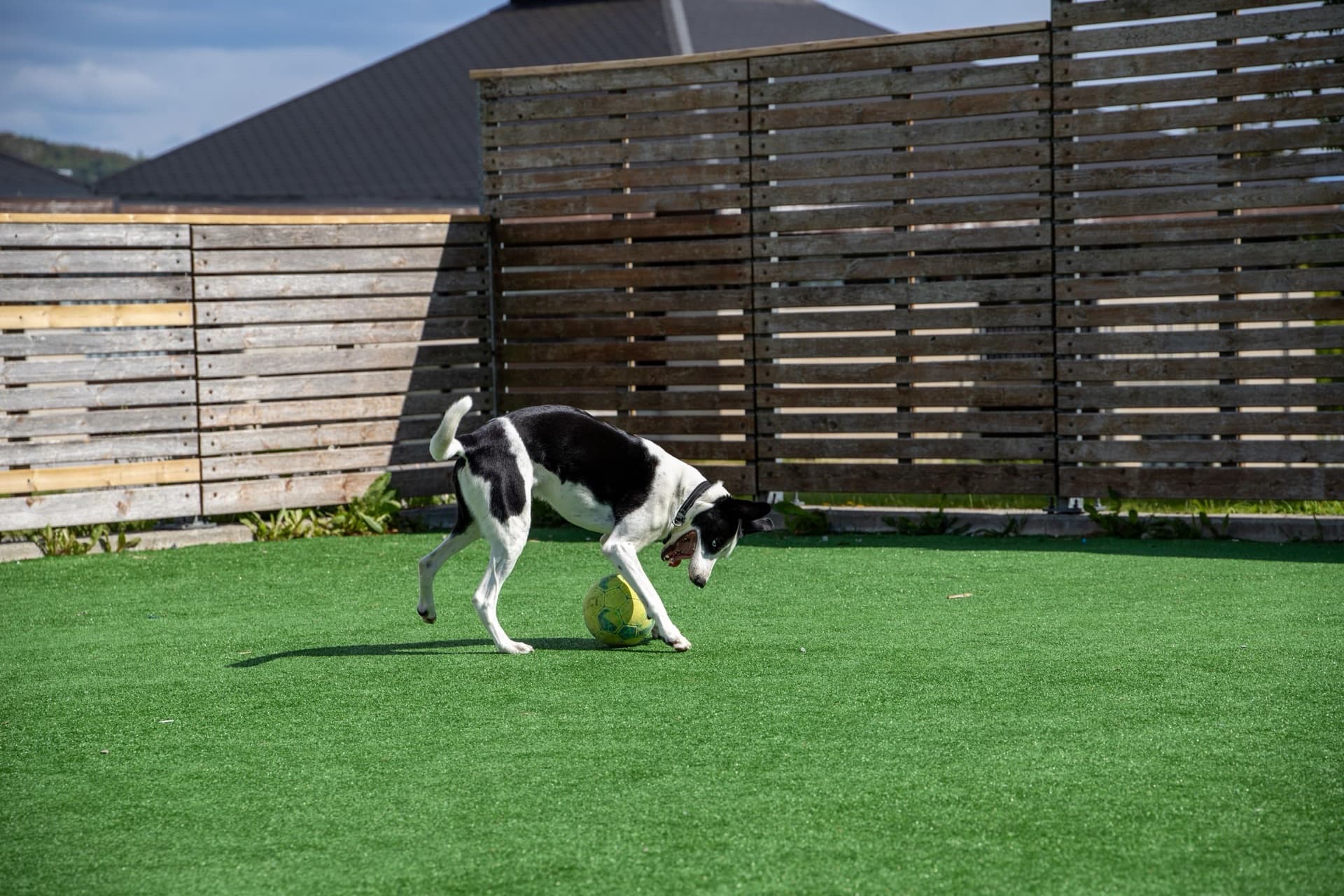
Why pet owners make the switch
If you're shopping for artificial turf for a dog yard in Australia, this page is the short path: what to look for in pet turf, which of our three rolls fits, what it costs, and how to keep it fresh through a hot summer. For the long version on breeds, diggers and infill, the guide to the best artificial grass for dogs goes further.
Ask anyone who's put turf in a dog yard why, and you'll get one of three answers: mud, holes or urine patches. Usually all three.
A real lawn plus a dog means muddy paws every wet week of winter, craters along the fence line, and brown rings wherever the dog pees, because urine is a nitrogen overdose for living grass.
Good artificial turf ends all three at once. There's no exposed soil to dig or churn into mud, and urine drains straight through the backing into the base below. Green yard, clean hallway.
The catch: turf that isn't specced for pets will flatten, trap smells and wear thin at the gate. Getting it right comes down to three things.
The 3-point pet spec
| Spec | What to look for | Why it matters for dogs |
|---|---|---|
| Drainage | Fully permeable backing with drainage holes across the whole sheet | Urine and hose water pass straight through instead of pooling |
| Pile height | 25-35mm | Long enough to feel like lawn, short enough to clean and brush back up |
| Backing | Dual-layer backing with strong tuft bind | Stops paws pulling fibres loose and holds up at high-traffic spots |
Pile height matters more than people expect. Under 25mm, turf feels a bit like carpet, though it cleans easiest. Over 35mm looks lush on day one, then flattens along the dog's running line and holds more of what gets left behind. The 25-35mm band is the working compromise; nearly every product sold as pet turf in Australia sits inside it. Our pile height guide walks through the trade-offs.
A compacted crusher-dust base under the turf does half the work too, letting urine drain away and rinse out with rain. Turf glued over smooth concrete with nowhere for liquid to go is where most smell complaints start.
Which turf suits your dog
For most pet yards, Turf Classic 30mm is the one we'd point you at: mid pile, permeable backing, dense enough to bounce back from daily zoomies, with the same resilience a busy play area needs from kids.
Turf Starter 20mm earns its keep in kennel runs, side strips and dedicated toilet zones. Short pile hoses off fast and dries quickly.
Turf Pro 40mm suits entertaining areas the dog shares rather than owns. It's the best-looking underfoot, but expect more brushing where the dog runs, because taller pile flattens sooner.
What pet turf costs in Australia
Australian market pricing for supply only, including GST, sits roughly in these bands: budget 15-25mm pile around $15-30 per m², mid-range 25-35mm around $30-45 per m², and premium 35-45mm around $40-60 per m². Professional installation typically adds $30-70 per m² on top, and DIY base materials (crusher dust, weed membrane, joining tape, pins and sand infill) usually land around $10-20 per m².
The useful thing for dog owners is that the 25-35mm pile that suits pets best sits in the mid-range band, so the right choice for the dog is also the middle price, not the top one. For our own range, see current pricing on the product page, where the calculator gives you an instant price for the length you pick, in about thirty seconds.
Before you order
Measure the area first. Our measuring guide covers rectangles, L-shapes and awkward corners, and why you always round up.
Pick the tier by how the dog uses the space: Classic 30mm for the main yard, Starter 20mm for toilet strips and runs, Pro 40mm for the entertaining lawn the dog only visits.
Add a waste allowance. Rolls commonly come 3.71m wide, so the shape of your yard affects offcuts as much as its area does. Five to ten percent covers most backyards.
Pick a length on the product page and order. Fixed cut lengths or full rolls, paid online, delivered Australia-wide direct from the supplier.
The simple cleaning routine
Pick up solids as you go, the same as on a real lawn. Let them dry slightly first; they lift off cleaner than from grass.
Hose the toilet zone weekly. A two-minute rinse pushes urine through to the base before it can concentrate.
Once a month, wash busy areas with a 50/50 white vinegar and water mix, or an enzyme cleaner from the pet shop.
Brush the pile back upright every month or two with a stiff broom, against the grain along running lines.
That's the whole job. The full schedule is in our artificial turf maintenance guide.
Two honest warnings
Heat
Artificial turf gets hotter than living grass in direct summer sun. On a 35°C afternoon an unshaded patch can be genuinely uncomfortable for paws. Plan some shade over part of the pet area, keep water out, and hose the surface before play on scorchers. The turf heat guide explains what temperatures to expect and when paws are at risk. And don't site a dog run in full western sun.
Smell
Odour comes from liquid that can't drain, so the fix lives in the base and the routine rather than the turf alone. A permeable base, drainage-focused turf and the weekly rinse will keep a one-dog yard fresh with almost no thought. With multiple dogs, ask about a zeolite deodorising infill in the toilet zone; it absorbs ammonia between rinses. Skip all that and a hot February will let you know, and if it already has, see how to remove dog urine smell from artificial grass for the fix.
Frequently asked questions
Is artificial grass safe for dogs?
Yes. Quality modern turf uses lead-free, non-toxic polyethylene and polypropylene fibres, safe for dogs to run, lie and roll on. It also removes the need for fertilisers, weed killers and pesticides, which are common causes of pet poisoning on natural lawns. Just confirm the supplier states the product is lead-free and made for landscape use.
Does dog urine make artificial turf smell?
Only if it can't drain. Urine that passes through a permeable backing into a compacted crusher-dust base flushes away with rain and a weekly hose-down. Smell problems almost always trace back to turf over sealed concrete where liquid pools, or rinsing that never happens. A monthly vinegar or enzyme wash plus zeolite infill in the toilet zone keeps even multi-dog yards fresh.
Can a dog dig through artificial turf?
Through the middle of a quality sheet, almost never; dual-layer backing is far tougher than claws. The weak point is the edges, where turf meets a fence or garden bed, so a proper install pins or fixes the perimeter securely. Most dogs give up once there's no soil reward, though escape artists may still test the fence line.
What pile height is best for dogs?
25-35mm is the sweet spot: it looks like real lawn, cleans easily and springs back from daily traffic. 30mm sits right in the middle of that range, the safest default for a family yard with a dog. Drop to around 20mm for kennel runs and toilet strips where fast hosing matters most, and save 40mm-plus for low-traffic areas where looks come first.
The range
All three finishes work for this, pick by pile height and budget, then choose your length.