Artificial Turf for Pool Surrounds: Soft, Green, No Mud
Artificial turf for pool surrounds: soft on wet feet, no mud or clippings in the water, and grippy when wet. See what to spec and price a length on the calculator.

By Wil McPherson · updated 27 August 2026
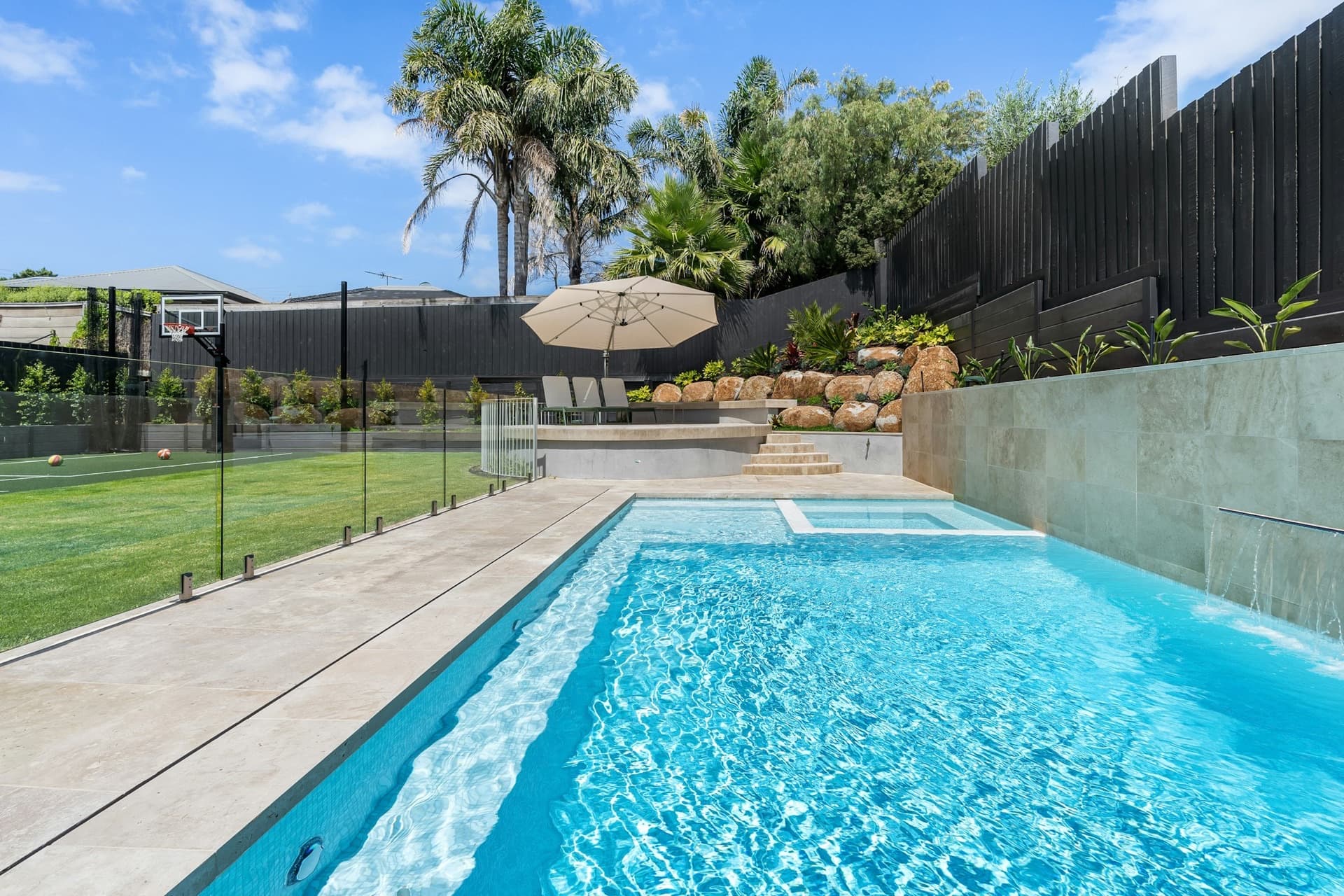
Why turf around a pool beats pavers on their own
A fully paved pool apron does the structural job, but living with it is another story. Pavers get hot, and they're hard on knees when kids inevitably go down. The glare off a big pale surface on a summer arvo is unpleasant too. Real lawn near the pool trades those problems for new ones: mud tracked into the water after rain, clippings blowing in every mow, and grass that browns off exactly where everyone walks.
A band of artificial turf between the coping and the fence fixes most of that in one go. There's no more mud tracked into the water or clippings in the skimmer box, and wet feet get a soft landing. It also stays green through winter and water restrictions, when real lawn looks its worst.
| Pavers only | Real lawn nearby | Turf + paver coping | |
|---|---|---|---|
| Mud in the pool | No | Yes, after rain | No |
| Clippings in the pool | No | Every mow | No |
| Soft underfoot | No | Yes | Yes |
| Green in winter | n/a | Usually patchy | Yes |
| Grip when wet | Varies by paver | Slippery when muddy | Good |
What to spec for the resort look
For pool surrounds, a 30-40mm pile is the sweet spot. Shorter budget turf (15-25mm) reads sparse next to water and flattens faster in high-traffic strips. A 30mm like Turf Classic 30 gives you the tidy, manicured look; a 40mm like Turf Pro 40 is denser and lusher, which is what most people mean by "resort style". The pile height guide covers the trade-offs.
On price, Australian market rates for mid-range 25-35mm turf sit around $30-45/m² supply only, and premium 35-45mm around $40-60/m², both inc. GST. Professional installation typically adds $30-70/m² on top. Our own range is on each product page with an instant calculator, so you can pick a length and get an instant price in a few seconds.
One worry we can put to bed: chlorinated and saltwater splash won't hurt quality turf. The fibres are polyethylene, the same family of plastic used in water tanks. An occasional hose rinse of the splash zone stops salt or chemical residue building up in the infill, and that's the whole job.
Get the drainage right at the coping
Turf drains through perforations in its backing, down into a compacted crusher dust base. Around a pool, two details matter. First, set your base falls away from the pool, same as with paving, so storm water doesn't carry fines toward the coping. A wet winter is the real test of that fall, so re-run a hose over the deck each spring as part of the pool deck reopening checklist and watch how fast the water clears. Second, finish the turf flush with or a few millimetres below the coping and fix it well there with pins or adhesive. A loose edge right where wet feet pivot is the first thing to lift. Our guide to what to spec for turf around a pool goes through the base fall, infill choice and coping fix in more detail.
The downside: heat
Artificial turf gets hotter than real grass in direct summer sun. On a 35°C-plus scorcher it can be uncomfortable on bare feet, and no infill or "cool" yarn fully escapes that physics; our guide to turf heat and burn risk covers the real numbers and what tames them. The good news: you're standing next to several thousand litres of water, and a 30-second hose-down drops the surface temperature fast. A border of light-coloured pavers as the main walking line helps too, as does a shade sail over the spot where people like to lie about.
Grip when wet
This one goes in turf's favour. Wet turf with sand infill stays grippy underfoot in a way smooth pavers and tiles don't, which matters when kids run the same wet loop all afternoon. The usual pool rules still apply, but it takes the sting out of the surface itself.
Curves, cutting and measuring up
Almost no pool is a rectangle, and turf comes on a fixed 3.71m wide roll. The method: treat each turf area as its bounding box, measure the longest side, and order the nearest available cut length that covers it. If the area is wider than 3.71m you'll need a second width joined alongside; if it's narrower, trim the excess away. Curves get cut on site with a sharp knife. Offcuts rarely go to waste; they patch the odd strip behind the filter box. The measuring guide walks through it with diagrams, and upkeep afterwards is a rinse and an occasional brush, covered in the maintenance guide.
Frequently asked questions
Does chlorine or salt water damage artificial turf?
No. Quality turf fibres are polyethylene, which is unaffected by normal pool chlorine levels and saltwater splash. The only upkeep is an occasional hose rinse of the splash zone so residue doesn't accumulate in the sand infill.
Is artificial turf slippery around a pool?
Turf with sand infill is one of the grippier wet surfaces you can put around a pool, noticeably better than smooth pavers or tiles. The fibres give bare feet something to bite into even when soaked. Normal pool supervision still applies, but the surface itself works in your favour.
How hot does turf get next to a pool in summer?
It gets hotter than real grass, and above about 35°C it can be uncomfortable on bare feet in full sun. A quick hose-down cools it within seconds, and light-coloured paver walkways or partial shade fix the main traffic lines. For most people it's a minor trade-off against mud-free, always-green surrounds.
Can artificial turf be cut to fit a curved pool?
Yes, easily. Order the nearest available cut length that covers the longest side of the bounding box, at the fixed 3.71m roll width, then cut the curve along the coping on site with a utility knife. Most surrounds need only one or two joins.
The range
All three finishes work for this, pick by pile height and budget, then choose your length.